
- ABB to supply power, propulsion and automation technology system for major New Zealand ferry project
- Reliability, flexibility and environmental performance of two new ships based on integrated ABB systems featuring Azipod® propulsion
- Project is part of Cook Strait Ferry Replacement Programme, one of New Zealand’s key infrastructure investments
02 September 2026 – ABB has been selected as the power, propulsion and automation technology partner for two new Ro-Pax ferries, to be named Kupe and Cook, which form part of Cook Strait Ferry Replacement Programme, one of New Zealand’s most strategically important infrastructure investments1. ABB will supply the integrated systems required to ensure the reliability, efficiency and environmental performance of the two ferries. To be built by Guangzhou Shipyard International (GSI) shipyard, the ferries will be delivered to New Zealand Government entity Ferry Holdings Limited in 2029.
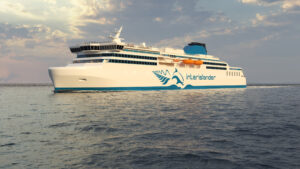
The 200-meter long, 28-meter-wide ferries will operate in the challenging conditions of the Cook Strait – Te Moana-o-Raukawa in Māori – at the junction of the Tasman Sea and the South Pacific Ocean, making the 92-kilometer Wellington-Picton crossing between the North and South Islands. They will offer capacity for 63 percent more passengers (1,530 persons) and 44 percent more freight (2,400 lane meters) than their predecessors. The ferries are rail-enabled, allowing rail freight to be loaded directly onto the vessels, eliminating multiple cargo handling steps during inter-island transfers.
Critical for the national economy, these vessels will also deliver high fuel efficiency, lower emissions and reduced underwater radiated noise (URN) that aligns with the most forward-looking ferry projects in the world. Reducing URN has been prioritized to help protect marine life in the Marlborough Sounds, acknowledged in the DNV SILENT-E class notation.
“These ferries represent a key investment in New Zealand’s transport infrastructure,” said Massimo Soprano, Ship Programme Director, Ferry Holdings Limited. “Selecting ABB gives us confidence that we will deliver vessels with world-class power, propulsion and automation technology. These systems are designed for the demanding conditions of Cook Strait and built to minimize environmental impact over their entire lifecycle.”
“Growing up on the shores of Lyall Bay in Wellington, I watched the ferries push out into Cook Strait in all conditions, wind, swell and everything in between. That image has stayed with me,” said Palemia Field, Global Segment Manager for Ferries, ABB’s Marine & Ports division. “That personal connection makes it even more meaningful to now be part of delivering vessels that will transform that crossing. They are quieter, cleaner, more reliable, and built for the next 30 years of New Zealand’s growth.”
Combining efficiency and environmental responsibility, ship specifications include a fuel agnostic hybrid-electric power and propulsion plant. The 8.2 MWh battery energy storage system installed will support near-zero-emission harbor operations or a spinning reserve for 10 minutes. The power architecture also allows for the Battery Energy Storage System (BESS) to scale up to 12.3 MWh with further potential capacity to align with shore charging technologies when available.
ABB’s scope of supply includes four main alternators, as well as motors and drives for the three bow thrusters. Two Azipod® propulsion units replace the predecessor ferries’ traditional propeller shafts, rudders and stern thrusters, delivering superior efficiency and a quieter, smoother ride. This is a meaningful improvement for passengers crossing the Cook Strait known for challenging and unpredictable conditions, strong tides and rough seas. The gearless, 360°-steerable Azipod® units also give the ships outstanding maneuverability. The ships will be able to crab2 at 1 knot of speed in 40 knots of wind from any direction, far exceeding what the current fleet can achieve during port entry and departures in Wellington and Picton.
At the heart of the ships’ power architecture sits ABB’s PEMS™ Power & Energy Management System, the intelligent ‘brain’ that continuously balances energy across the vessels’ generators, battery energy storage system, propulsion and auxiliary loads. Rather than managing these as separate systems, PEMS™ treats them as one integrated whole: automatically optimizing fuel consumption, enabling harbor operations on battery power alone, and maintaining power continuity in the event of a fault. This level of integration and built-in resilience ensures unmatched operational reliability. PEMS™ has proven this capability across multiple ABB ferry projects worldwide.
The system will be complemented with the ABB Ability™ Remote Diagnostic System (RDS) for continuous 24/7 monitoring and access to ABB’s global network of experts. The digital solution enables predictive maintenance, faster troubleshooting, and real-time operational insights, helping operators enhance vessel availability, reduce lifecycle costs, and ensure safe and efficient operations.
For ferries at the heart of New Zealand’s freight and passenger network, where an unplanned outage would have direct consequences for schedules, impacting rail connections and thousands of travelers, the ability to detect and resolve issues remotely before they lead to failures is a genuine operational differentiator.
1https://www.ferryholdings.co.nz/wp-content/uploads/2026/07/FHL-17-July-2026-Media-Pack.pdf
2“Crabbing” refers to the ability of a vessel to move sideways – laterally across the water – without changing the direction the bow is pointing, in the same way a crab walks. This maneuver requires the ability to generate thrust in any direction simultaneously and is critical for safe docking in strong crosswinds and currents. It is made possible by Azipod® thrusters, which can rotate a full 360°, combined with bow thrusters at the forward end of the vessel.
About ABB
ABB is a global technology leader in electrification and automation, enabling a more sustainable and resource-efficient future. By connecting its engineering and digitalization expertise, ABB helps industries run at high performance, while becoming more efficient, productive and sustainable so they outperform. At ABB, we call this ‘Engineered to Outrun’. The company has over 140 years of history and around 110,000 employees worldwide. ABB’s shares are listed on the SIX Swiss Exchange (ABBN) and Nasdaq Stockholm (ABB). www.abb.com
ABB’s Automation business automates, electrifies and digitalizes industrial operations that address a wide range of essential needs – from supplying energy, water and materials, to producing goods and transporting them to market. With its ~26,000 employees, leading technology and service expertise, Automation helps process, hybrid and maritime industries outrun – leaner and cleaner. go.abb/automation