
15 September 2026 – ClassNK has issued an Approval in Principle (AiP) for the design concept of a 42,000 m³ liquefied CO₂ carrier jointly developed by Kawasaki Kisen Kaisha, Ltd. (“K” LINE), Mitsui O.S.K. Lines, Ltd. (MOL), Nihon Shipyard Co., Ltd. (NSY), Nippon Yusen Kabushiki Kaisha (NYK Line), MILES Co., Ltd., and Mitsubishi Shipbuilding Co., Ltd. A certificate handover ceremony was held at Gastech2026 in Bangkok, Thailand.
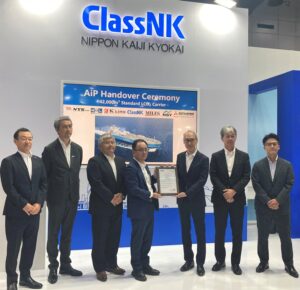
Mr. Yasushi Yamamoto, Executive Officer, NYK Line
Mr. Yoshihiko Sugimoto, Executive Officer, MOL
Mr. Harunobu Akiyama, Executive Officer, “K” LINE
Mr. Hayato Suga, President & CEO, ClassNK
Mr. Manabu Kawakado, President, MILES
Mr. Shinya Narama, Vice President, NSY
Mr. Yusuke Watanabe, Senior Vice President, Mitsubishi Shipbuilding
While Carbon dioxide Capture and Storage (CCS)*1 projects are proceeding worldwide, demand for liquefied CO₂ carriers that transport CO₂ from the capture site to the storage site is expected to expand. This AiP is a step toward standardizing hull designs, which is necessary in order to realize a sufficient number of liquefied CO₂ carriers to meet such demand.
For this design concept, ClassNK carried out a design review based on Part N of its ‘Rules and Guidance for the Survey and Construction of Steel Ships’, which incorporates the IGC Code, an international code prescribing the safety requirements for the construction and equipment of ships carrying liquefied gases such as liquefied CO₂ and LNG in bulk, together with a risk assessment through HAZID. ClassNK issued the AiP after it was confirmed that the prescribed requirements were met.
ClassNK will continually strive to contribute to the development of new technologies and their social implementation through safety assessments and more.
*1 Carbon dioxide Capture and Storage (CCS)
Technology for separating and capturing CO₂contained in emissions and storing it in stable underground formations.
Approval in Principle (AiP):
At the initial stage of designing or before the specific target ship to be implemented is decided, the design is examined based on the existing regulations such as international conventions and ship classification rules, and an Approval in Principle (AiP) is issued as proof of conformity with requirements. It also prevents rework of regulatory aspects in the post-process, shortens the examination time at the time of class registration, and can be used as a technical basis for external appeal of the design status. For more information, visit our website.