
Posted in Marine industry talk
Compare and Despair as the trite advice goes. So, does relative truth within the cliché stand up to a comparison between women in shipping and other sectors on this International Day for Women in Maritime?
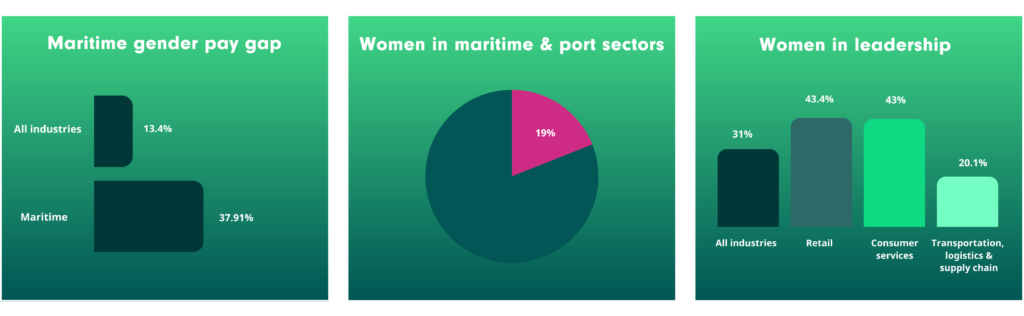
As a survey of 2,000 shore-based positions in the UK across Maritime HR Association members from recruiter Spinnaker suggested in January, comparisons will be disappointing for those seeking to hit the jackpot. It reported a maritime mean gender pay gap between men and women of 37.91% (median 36.46%), compared to a mean of 13.4% (median 12.8%) across all industries.
If replicated elsewhere (global figures are elusive), the finding offers one area for focus in any move “From Policy to Practice”, as the IMO’s mission for 2026 has it, in “Advancing Gender Equality for Maritime Excellence”.
It may also represent one reason for the low participation of women in the maritime industries, whether they come “under the purview” of the IMO or are part of the wider ports and logistics sector.
Where the WISTA-IMO Women in Maritime Survey 2024 counted female employees as “just under 19%” of its sample, the latest UNCTAD ‘Port Performance Scorecard’ (PPS) analysis of 76 ports also reports women as making up 19 per cent of the workforce.
The WISTA-IMO survey report makes explicit reference to the need for action on pay disparities, but there is also evidence to suggest that – all other things being equal – “gender neutral” technology and digitalisation could have a role in narrowing the gender gap.
For shore-based roles, the proposition is supported in the technology training World Maritime University experts offer to female maritime professionals from the developing world as part of the IMO-Republic of Korea backed SMART-C Women Project. In its largest cohort to date, 40 female maritime professionals took part in SMART-C sessions held during March.
In the ports sector, technology may be breaking down barriers. According to UNCTAD’s PPS, women occupy 39% of positions in port administration, but only 2% in cargo handling. However, in one recent example, 25 percent of personnel working in the remote crane operations centre at the new Colombo West International Terminal are women.
But technology is only one part of any working life, and beyond equity of pay, there are other practical measures to consider. At sea, for example, there is simply insufficient protective gear designed for women and inadequate sanitary provisions.

Maritime women also face insufficiently family-friendly policies, although here caution is advisable, given that standards vary between nation states and shore-based employers as well as between shipping organisations.
Even so, the lack of seafarer maternity rights has been highlighted by the Nautilus Equality and Diversity Forum as a block on seagoing careers. “Structured pathways back to sea” are missing, according the Global Maritime Forum’s All Aboard Alliance. Surely this is one reason why, if women contribute 19% to the maritime workforce, they contribute only one percent of active seafarers according to IMO-WISTA.
Negative stereotyping – and worse – are further deterrents. A 2024 International Maritime Health journal report found over two thirds of women seafarers had experienced sexual harassment in their working life. For context, Women In the Workplace 2025: Key Findings and Takeaways reports the comparable figure as 40% of women ashore in corporate America, with the European Institute for Gender Equality reporting 42% of women aged 18-29 as having experienced sexual harassment at work.
Nevertheless, role models provide inspiration for change and every female success story at sea is a cause for celebration. Furthermore, as it is natural for those entering the workforce to look for guidance to the ones who went before, WISTA women seek to help shipping’s next generation by focusing on policy that can become practice, as well as meeting people. Networking is invaluable in business, but strategy is the basis for success.
In conclusion, it may be worth noting that research from consultancy ISS‑Corporate and The State of Women in Leadership: Global Employment Trends in 2026 study, published by LinkedIn, suggest that women hold around 31.0% of leadership roles globally.
But while female leaders contribute 43.4% and 43.0% respectively to retail and consumer services sectors, the share amounted to 20.1% in the transportation, logistics, supply chain and storage segment.
Therefore, as the LinkedIn study authors note: “Progress in leadership representation rarely happens quickly. It develops through everyday decisions about hiring, promotion and opportunity. While movement continues, sustained attention is still needed.”